The Three Cities sit directly across the Grand Harbour from Valletta — close enough to see, quick to reach, but just far enough to feel like a different world. This guide covers every practical way to make the crossing, plus how to get around once you arrive.
This guide is part of our complete guide to the Three Cities of Malta — Birgu, Bormla and Senglea.
The ferry — the best way to cross
Valletta Ferry Services runs a regular passenger ferry between Valletta and the Three Cities. The crossing takes about ten minutes, departing from the Valletta waterfront (below Upper Barrakka Gardens) and arriving at the Cospicua terminal — right at the edge of Bormla, within walking distance of Birgu and Senglea. Ferries run roughly every thirty minutes during peak hours.
A single ticket costs around €1.50. The Tallinja card (Malta’s public transport card) works on the ferry too, at an even lower fare. Buy one at the airport, Valletta bus terminus, or online.
The ferry is faster than the bus, cheaper than a taxi, and the crossing itself — passing beneath Valletta’s bastions with Fort St Angelo ahead — is one of Malta’s best ten-minute experiences. Evening crossings with the harbour lit up on both sides are particularly good.
Tip: Check the timetable before planning an evening crossing. Last ferries run around 19:00 in winter and later in summer. Services may be reduced on public holidays.
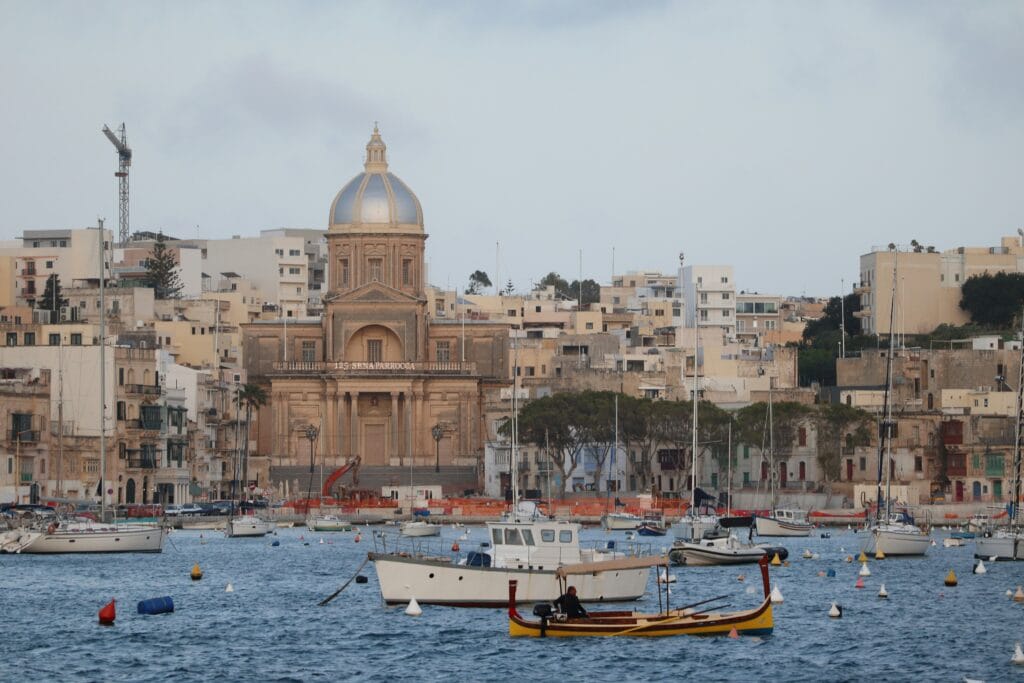
The dgħajsa — the traditional crossing
Before the modern ferry, people crossed the Grand Harbour by dgħajsa (pronounced “die-sa”) — a traditional Maltese water taxi, hand-painted in bright colours and rowed by skilled boatmen. The dgħajsa has carried passengers across these waters for centuries, and you can still take one today.
Boatmen operate from the Valletta waterfront and the Birgu side, offering crossings on demand. It costs more than the ferry — a few euros per person — but the experience is worth it at least once. Sitting low on the water, passing beneath the massive bastions, with the sound of oars — this is how Malta’s harbours were meant to be experienced.
Tip: Dgħajsa services are informal with no fixed timetable. Availability is weather-dependent and seasonal. Ask at the waterfront if you don’t see anyone — they’re often nearby.
By bus from Valletta
Routes 1, 2, and 3 depart from Valletta bus terminus (just outside the city gate), passing through Cospicua (Bormla) and continuing to Vittoriosa (Birgu). The journey takes fifteen to twenty minutes. Fares: €1.50 in winter, €2.00 in summer, or €0.75 with a Tallinja card. The card also gives free transfers within two hours.
The ferry is faster and more scenic for Valletta crossings, but buses are essential for reaching places the ferry doesn’t go — the airport, Marsaxlokk, Mdina, or the north coast. The main bus stop in Bormla connects to routes across Malta.
Tip: Download the Tallinja app for real-time bus tracking — Malta’s buses don’t always run to schedule. Buy a Tallinja card at the airport when you arrive.
Walking from Valletta
Start at the Upper Barrakka Gardens, take the Barrakka Lift down to the waterfront (free, runs daily), then follow the harbour-side road south toward Cospicua. The walk takes thirty to forty minutes. The first section offers views across to the Three Cities; the middle stretch passes a more industrial dock area. Once you reach the Cottonera Gate or Bormla’s waterfront, you’re there.
Worth doing once for the sense of scale — you’ll see how the Three Cities relate to Valletta geographically. For regular trips, the ferry is faster and easier.
Tip: If the Barrakka Lift is out of service, there are stairs — steep and long. Check before you commit.
From the airport
Malta International Airport is fifteen to twenty minutes from the Three Cities by car. Taxi apps (Bolt and eCabs) cost around €15–20. By bus, take any route to Valletta bus terminus, then connect to route 1, 2, or 3 — about forty-five minutes total, under €4 with a Tallinja card.
Tip: If arriving late at night, pre-book a taxi. Night bus options from the airport are limited.
Getting around the Three Cities
Everything is walkable. Bormla to Birgu along the waterfront takes about fifteen minutes — flat, scenic, past the marina. Birgu to Senglea adds another ten minutes. You can walk through all three towns in an afternoon. Wear comfortable shoes — the streets are old, uneven, and full of steps. Limestone gets slippery after rain.
Parking and car rental
Street parking in Bormla is free and usually available — the square in front of Magdalena typically has spaces. Compare this to Valletta (limited, expensive) or Sliema (paid zones, circling for twenty minutes) and the difference is clear. Birgu is tighter; Senglea is limited but manageable.
For the Three Cities and Valletta, you don’t need a car — the ferry, buses, and your feet cover everything. Many Magdalena guests spend their entire stay without one. A car becomes useful for day trips: Gozo, beaches on the north coast, Mdina, the Blue Grotto. Renting for two or three days mid-trip is a good strategy. Cars are affordable — often under €25 per day outside peak summer. Drive on the left.
Tip: If you’re only visiting the Three Cities and Valletta, skip the car. The ferry is more pleasant than driving, and you’ll save the stress of Maltese roundabouts.
Stay in the heart of it
Magdalena is five minutes on foot from the ferry terminal in Bormla — ten minutes from Valletta by boat. A restored Maltese townhouse, available as a self-catering holiday home. Book directly for the best rate.
Stay at Magdalena
A restored 400-year-old townhouse in the heart of Bormla — ten minutes by ferry from Valletta, sleeping up to three. Book direct and save up to 15% — no booking fees, best-rate guaranteed.
Owned & run by Christine & Dick · confirmed within 24 hours